About Me

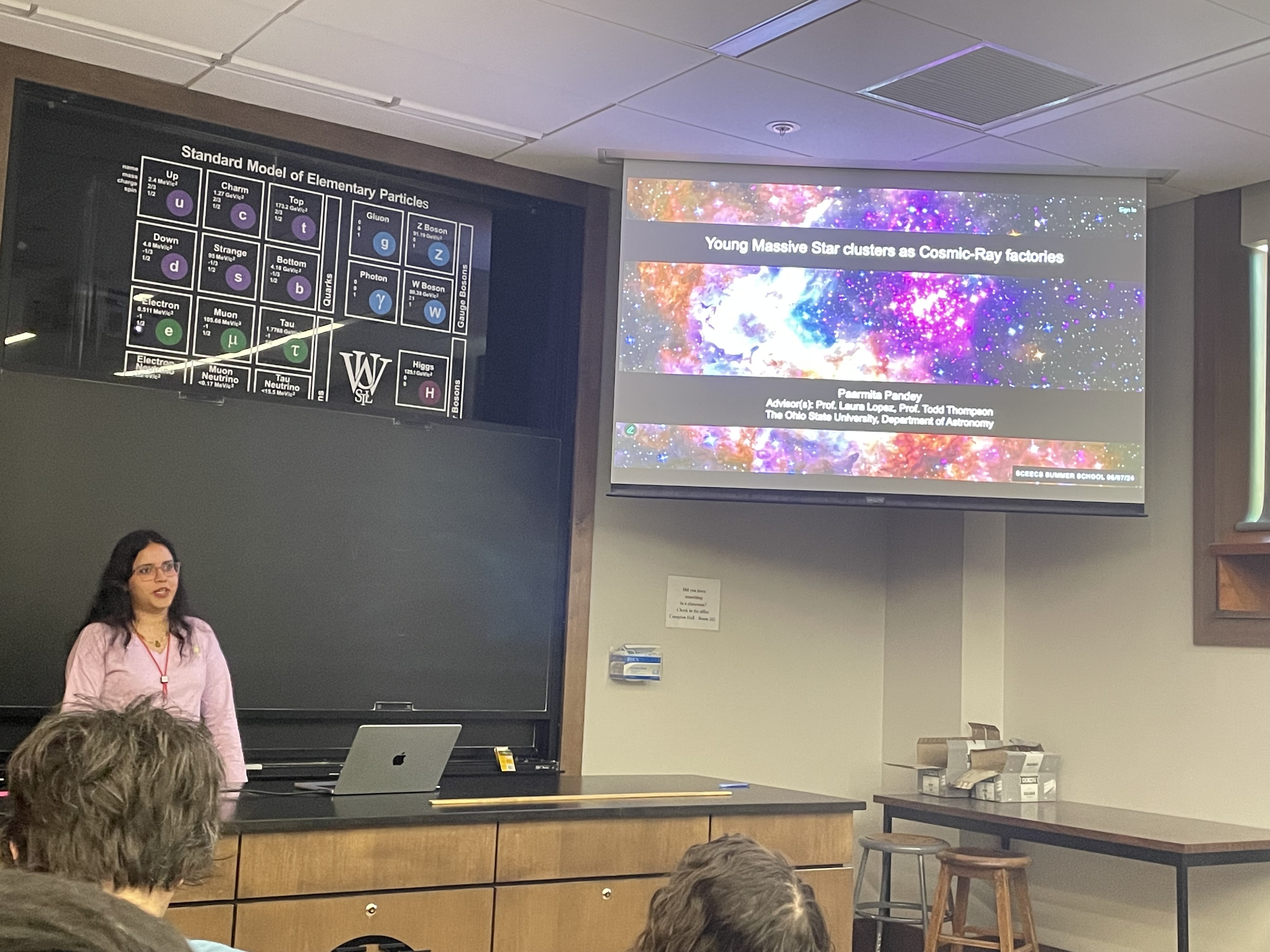
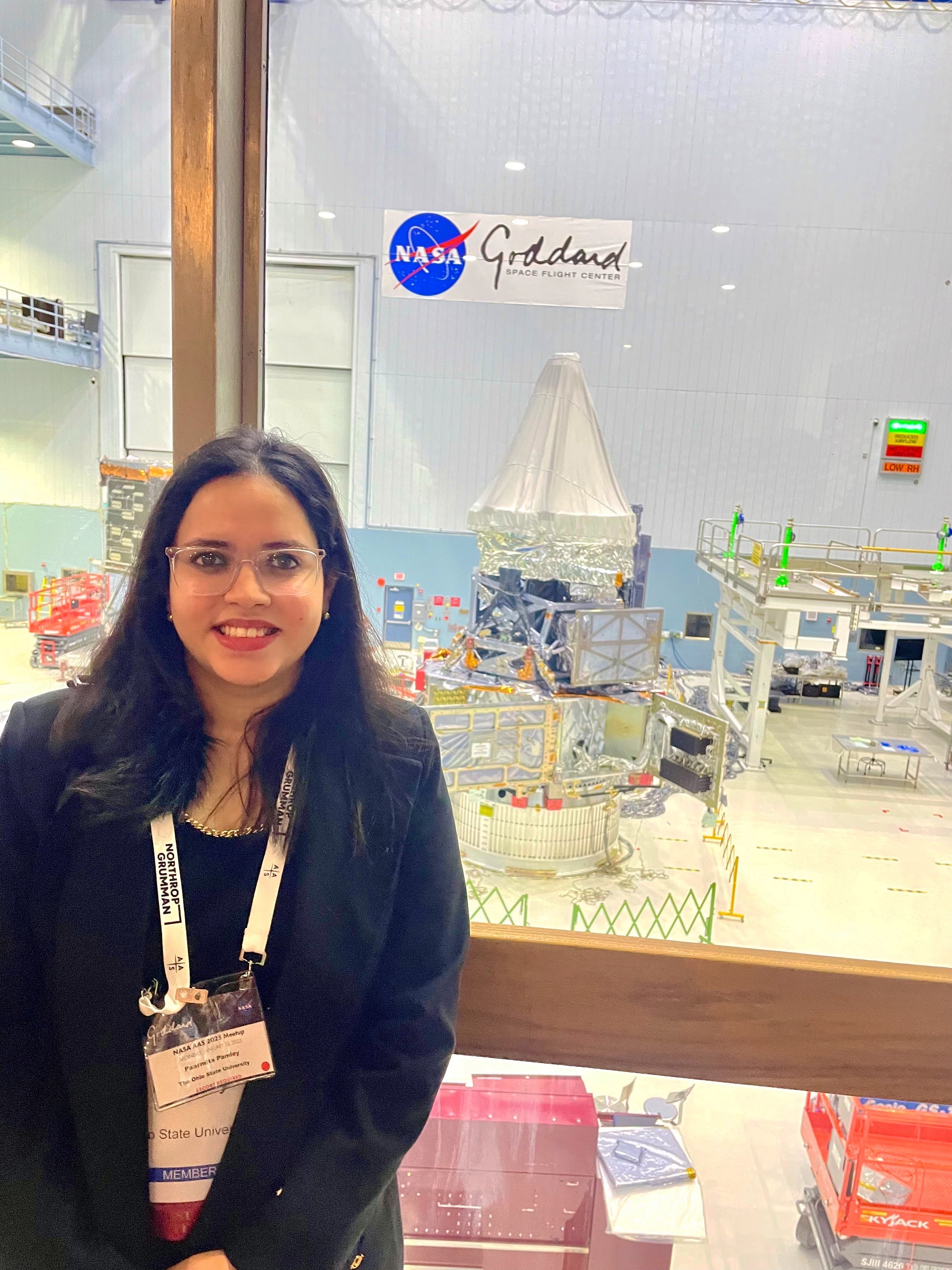
Hello! My name is Paarmita Pandey. I am a 4th-year PhD Candidate at The Ohio State University, Department of Astronomy. I am primarily a multiwavelength observational astronomer, with broad interests.

I work with Prof. Laura Lopez and Prof. Todd Thompson on understanding Cosmic-Ray Acceleration and Transport in Star-Forming Galaxies using Fermi-LAT gamma-ray data.

I also work with Prof. Chris Kochanek and the ASAS-SN team on analyzing the new class of transients known as Ambiguous Nuclear Transients (ANTs).

Cosmic Ray Acceleration in Young Star Forming Regions

Keywords: Fermi-LAT, Stellar Winds, Diffusion Coefficient

Cosmic rays play a key role in shaping galaxies, influencing how they form and evolve. Understanding where these high-energy particles come from is therefore essential for modeling galaxy evolution and cosmic-ray feedback. While supernova remnants are traditionally considered the main accelerators of cosmic rays, recent observations suggest that young, massive star-forming regions may also contribute significantly. In this work, we use Fermi-LAT gamma-ray observations to investigate cosmic-ray acceleration in two such environments.

First, we look at the young star-forming region RCW 38 (age < 0.5 Myr), where we detect gamma-ray emission at a 22σ significance level, providing strong evidence that stellar winds can accelerate cosmic-ray particles. These observations allow us to constrain the cosmic-ray acceleration efficiency, diffusion timescales, and pressure within the region.

We also identify a new class of Fermi gamma-ray sources associated with explosive outflows, focusing on DR21 in the Cygnus-X star-forming complex, detected at 35σ significance. For this system, we quantify the acceleration efficiency of explosive outflows and evaluate their contribution to the overall galactic cosmic-ray budget. Overall, our results show that star-forming regions younger than ~3 Myr are efficient cosmic-ray accelerators, with important implications for galaxy simulations and for understanding the origin of galactic cosmic rays.

Read the full article on RCW 38 here.

Read the full article on Explosive Dispersal Outflows here.

Unraveling the Nature of the Nuclear Transient AT2020adpi

Keywords: Active Galactic Nuclei, Tidal Disruption Events

I study transient events associated with supermassive black holes, which offer unique insights into accretion physics in galactic nuclei. In a recent multiwavelength study, I analyze AT2020adpi, a luminous optical/UV nuclear transient at z = 0.26 that does not fit cleanly into existing categories such as tidal disruption events or standard AGN variability. Its unusual light curve, strong mid-infrared flare, and evolving emission-line features suggest an accretion episode driven by either a stellar disruption within an active disk or instabilities in an active nucleus. This event highlights both the diversity of nuclear transients and the importance of coordinated, multiwavelength observations.

Project 2 plot

Read the full article here.

Skills

Programming

I am proficient in Python (NumPy, Pandas, SciPy, scikit-learn), C, and Mathematica.

Plotting & Visualization

I am experienced with Matplotlib, Seaborn, and DS9.

Observing Experience

3 nights of observations with the Large Binocular Telescope (LBT) as an assistant observer.

Data Science

Completed the 12-week Erdős Data Science Bootcamp with Distinction Award (Summer 2025).

  • I was a part of team project: “Tracking the Shift of Tornado Alley Using NOAA Storm Data” — where I analyzed 70 years of storm frequency, magnitude, and area-of-effect data across the continental US to model geographic shifts using machine learning and regression.

Astronomical Data Analysis

Multiwavelength analysis experience from gamma-rays to infrared: Fermi-LAT, Swift UVOT, ZTF, Gaia, ATLAS, WISE, Spitzer.

Mentoring & Outreach

I come from a small town in India where access to education for women is limited. Without early mentors, I found guidance only in college. It was an experience that shaped my journey and inspired my commitment to mentorship.

I am part of the leadership team of the Supernova Foundation, serving as the Outreach and Mentoring Coordinator. The Supernova Foundation is a global mentoring program dedicated to empowering young women and gender minorities pursuing careers in Physics. As of October 2025, it supports 400+ members across 50+ countries.

I also mentor students through the Polaris Mentorship Program, supporting and broadening participation of undergraduate students in Physics and Astronomy through academic and professional guidance.

Through these roles, I aim to support various scientific communities by ensuring that aspiring astrophysicists receive the mentorship and support I once lacked.

Have questions? Wish to collaborate? Reach out to me via email - pandey.176@osu.edu